 An Garda Síochána
Frequently Asked Questions
Vetting is conducted by the National Vetting Bureau (formerly known as the Garda Central Vetting Unit).
No. Vetting is conducted only on behalf of relevant organisations that are registered with the National Vetting Bureau and is not conducted for individual persons on a personal basis.
The procedure is as follows:-
- Persons who are subject to vetting will receive a vetting application form (including electronic form) from the relevant organisation where they are seeking a position.
- The applicant completes the application form and returns it to the relevant organisation and provides proof of identity.
- A Liaison Person in the relevant organisation forwards the form to the National Vetting Bureau.
Section 13(6) of the Act provides for vetting of persons under 18 years of age. The Act states that if a person in respect of whom an application for a vetting disclosure is made is under 18 years of age, a declaration of consent (Parent/Guardian Consent Form) is completed on his or her behalf by a parent or guardian of the person.
The following information is required to be provided on a vetting application form:
- Your Name(s) and any other Name(s) you are known as or have been known as
- Gender
- Date of Birth
- Place of Birth
- Country of Birth
- Mother’s Forename
- Mother’s Surname
- Passport Number where applicable
- Passport Issuing Country
- Father’s Forename
- Father’s Surname
- Job Role
- Your current address and previous addresses (if any)
- Particulars of any criminal record
There is no requirement in the Act for the provision of PPS numbers by vetting subjects.
An application for a vetting disclosure under Section 13 of the Act shall include the information specified in subsection (5) in relation to the person. A passport number, if available, is specified in this subsection.
A criminal record in relation to a person means a record of the person’s convictions whether within or outside the state for any criminal offence together with any ancillary or consequential orders made pursuant to the convictions concerned or a record of any prosecutions pending against the person whether within or outside the state for any criminal offences or both.
A person shall not be obliged to provide details of any convictions to which Section 14A of the National Vetting Bureau (Children and Vulnerable Persons) Acts 2012 to 2016 applies.
Yes. The definition of criminal record includes a record of any prosecutions pending against a person, whether within or outside the State, for any criminal offence.
Where the National Vetting Bureau receives an application for a vetting disclosure in respect of a person concerning relevant work or activities, the National Vetting Bureau shall make such enquiries of An Garda Síochána as it deems necessary to establish whether there is any criminal record or specified information relating to the person.
No. Persons who are subject to vetting will receive a vetting application form (including electronic form) from the relevant organisation where they are seeking a position. The applicant completes the application form, where they sign a declaration allowing the relevant organisation to send in the Vetting application and return it to the relevant organisation and a Liaison Person in the relevant organisation will forward the form to the National Vetting Bureau.
Section 32 of the Act states that the Minister may, after consultation with the Garda Commissioner and with the consent of the Minister for Public Expenditure and Reform, by regulations prescribe fees.
A person guilty of an offence under section 26 shall be liable -
- on summary conviction, to a class A fine or imprisonment for a term not exceeding 12 months or both, or
- on conviction on indictment, to a fine not exceeding €10,000 or imprisonment for a term not exceeding 5 years or both.
Yes. If you correspond directly with the National Vetting Bureau to withdraw your application, the National Vetting Bureau will inform the relevant organisation.
The law requires that you disclose all of your previous names and addresses to the National Vetting Bureau (NVB) so that your application can be correctly processed. The NVB does however have a process whereby you can disclose your previous gender/name to the NVB only and not reveal this data on the vetting application form.
This is known as the ‘Sensitive Applications Process’. This process ensures that your information is handled sensitively and securely by the NVB and not revealed to the registered organisation seeking vetting in respect of you.
In order to utilise this process you must contact the NVB’s Sensitive Applications Team. This will ensure that your previous gender/name is not released while permitting you to comply with the law. A member of the team will be able to answer all of your questions about completing the application form and will record your details so that we can track your application when it arrives. Once it arrives at the NVB we will monitor your application and check the content of your NVB disclosure before it is issued.
Contact 0504-27300 and look for the Sensitive Applications Team.
A vetting disclosure shall include particulars of the criminal record (if any) relating to the person, and a statement of the specified information (if any) relating to the person or a statement that there is no criminal record or specified information, in relation to the person.
The relevant organisation in accordance with the National Vetting Bureau Act shall, as soon as practicable, make available a copy of the vetting disclosure to the applicant.
The Applicant should outline in writing to the Liaison Person in the relevant organisation the exact basis of their dispute. The Liaison Person should submit the Applicant’s report to the National Vetting Bureau. Further checks will be carried out by the National Vetting Bureau who will correspond with the Liaison Person in course.
No. All decisions in respect of the suitability of applicants for positions in relevant organisations are the sole responsibility of the relevant organisation concerned. The National Vetting Bureau has no input into any decision made in any relevant organisation in respect of the suitability of an applicant for a position within such an organisation.
The Act states that a relevant organisation shall not permit any person to undertake relevant work or activities on behalf of the organisation unless the organisation receives a vetting disclosure from the National Vetting Bureau in respect of that person. There are 2 exceptions
Where an organisation applies for vetting disclosures to the Bureau through another relevant organisation that is registered on the register of relevant organisations and the other relevant organisation are processing vetting applications on their behalf and
Where relevant organisations have in place a joint agreement in accordance with Section 12(3A) of the Act.
Yes. The written consent of the vetting subject must be obtained and the request must be forwarded in writing to the National Vetting Bureau.
Specified information in relation to a person who is the subject of an application for a vetting disclosure means information concerning a finding or allegation of harm to another person received by the Bureau from An Garda Síochána or a scheduled organisation pursuant to section 19 of the Act. It is information that is considered to give rise to a bona fide concern that the vetting subject may harm, attempt to harm or put at risk a child or vulnerable person or both. If such information is going to be disclosed to a relevant organisation relating to one of their applicants, the Chief Bureau Officer must, in advance, notify the vetting subject of the intention to disclose the information.
Section 19 of the Act states that where, following an investigation, inquiry or regulatory process (howsoever described) in respect of a person, (including an investigation, inquiry or regulatory process initiated but not yet concluded before the commencement of this section) a scheduled organisation, has as a result of the investigation, inquiry or regulatory process, a bona fide concern that the person who is the subject of that investigation, inquiry or regulatory process, may—
- harm any child or vulnerable person,
- cause any child or vulnerable person to be harmed,
- put any child or vulnerable person at risk of harm,
- attempt to harm any child or vulnerable person, or
- incite another person to harm any child or vulnerable person, the scheduled organisation shall, as soon as may be, for the purposes of providing specified information to the Bureau, notify the Bureau in writing of that concern and shall state the reasons for it.
The decision to disclose specified information requires the Chief Bureau Officer to believe that the information in question is of such a nature as to give rise to a bona fide concern that the vetting subject may harm, attempt to harm or put at risk of harm a child or vulnerable person.
A Schedule 2 organisation vetting refers to a specific obligation under Ireland's National Vetting Bureau (Children and Vulnerable Persons) Acts 2012–2016 for organisations listed in Schedule 2 to notify the Garda National Vetting Bureau (GNVB) if they have a bona fide concern that a person they are vetting may harm a child or vulnerable person. This "specified information" is in addition to the standard criminal record checks and is crucial for preventing harm to children and vulnerable persons by allowing for the exchange of sensitive information.
The Health Service Executive.
The Teaching Council.
The Medical Council.
The Nursing and Midwifery Board of Ireland.
The Dental Council.
The Health and Social Care Professionals Council.
The Mental Health Commission.
The Pharmaceutical Society of Ireland.
The Pre-Hospital Emergency Care Council.
The Health Information and Quality Authority.
The National Transport Authority.
The Child and Family Agency.
Fiosrú - Oifig an Ombudsman Póilíneachta.
Yes. The vetting subject shall be informed in writing by the Chief Bureau Officer of his or her intention to disclose specified information and shall furnish him or her with a summary of the specified information. The vetting subject shall also be informed that he or she may make a written submission in relation to the specified information concerned. A person who is aggrieved by a determination of the Chief Bureau Officer may, not later than 14 days after the date the notification of the determination is sent to the person, appeal to an appeals officer against that determination. A person may appeal to the high court from a determination of an appeal by an appeals officer on a point of law and the determination of the high court on such appeal shall be final and conclusive.
The applicant must manually complete and forward the Vetting Invitation Form to a relevant organisation and provide proof of identity. The relevant organisation confirms proof of identity and sends the applicant an Email with a link attached inviting him/her to complete the vetting application online.
They must provide their forename(s), surname, date of birth, Email address, contact number, job role, current address and sign and date the Invitation Form.
The relevant organisation provides the Invitation Form to the applicant.
The link will expire after 30 days. The applicant will then have to re-apply to the relevant organisation to resend the link.
Yes. A reminder Email is sent after 21 days if no reply has been received from the applicant.
No. The application goes to the relevant organisation. They will review the application and submit it to the National Vetting Bureau.
Yes. The applicant may click on the link received in the original Email from the relevant organisation. From here, they can go to the Track Application section to see the status of their application.
The vetting disclosure is issued to the relevant organisation. The relevant organisation in accordance with the National Vetting Bureau Act shall, as soon as practicable, make available a copy of the vetting disclosure to the applicant.
The applicant may complete a paper application form and send it to the relevant organisation who will enter the details onto the eVetting website and submit to the National Vetting Bureau.
No. Once a relevant organisation signs up for eVetting, all applications must be submitted online to the National Vetting Bureau.
You can access the Vetting website through the Internet on browsers such as Chrome, Firefox, Microsoft Edge, and Safari. Vetting supports the latest versions of each of these browsers
- Microsoft Edge *
- Latest Chrome
- Latest Firefox
- Latest Safari
Regardless of your browser type, you must have cookies and Java script enabled.
Please note that Internet Explorer is no longer supported. (Microsoft ended the support for Internet Explorer in June 2022)
* Running Microsoft Edge in IE compatibility mode is not supported for this application.
To access Vetting for mobile web browsers, your mobile browser needs to fit a few minimum requirements.
First, make sure your browser is XHTML compliant. If you're not sure if it is, you can visit http://www.google.com/xhtml and perform a search. If it doesn't work, your browser may not be XHTML compliant.
You can contact your mobile service provider to check the following requirements:
- Your browser should have cookies enabled and your network should also allow cookies. The setting for cookies is usually located in your phone's browser settings.
- Your network should allow secure SSL traffic.
- Your mobile browser must have a URL length of 2000 bytes.
- Your mobile browser must allow redirects of 10.
If you're seeing problems in how the Vetting website is displaying in your browser; it may be neccessary to clear your cache and cookies.
Review and follow the instructions provided by your browser:
Details and alternatives
Effect of clearing cache and cookies: Keep in mind that clearing your cache and cookies erases your settings for websites. Here are some examples:
- If you opted to have your browser remember your username and password, it will be cleared from your browser's memory when you clear cache and cookies.
- The eVetting portal might load a little slower because all of the images and content pieces have to be loaded from scratch.
Recommended first step: If you're seeing problems in how webpages are displayed in your browser, we suggest first using your browser’s incognito or private browsing mode to see if the problem you're seeing is caused by something other than cache or cookies.
The Act will provide a legislative basis for the mandatory vetting of persons who wish to undertake certain work or activities relating to children or vulnerable persons or to provide certain services to children or vulnerable persons.
Any person engaged by a relevant organisation organisation to carry out work or activity which falls within the definition of relevant work or activity as provided at Schedule 1 Part 1 relating to children and Schedule 1 Part 2 relating to Vulnerable Persons is required to be vetted by the organisation responsible for assessing the suitability of the individual to carry out relevant work or activity
In the Act, a child is defined as a person under the age of 18 years.
A vulnerable person means a person, other than a child, who is suffering from a disorder of the mind, whether as a result of mental illness or dementia, has an intellectual disability, is suffering from a physical impairment, whether as a result of injury, illness or age, or has a physical disability, which is of such a nature or degree as to restrict the capacity of the person to guard himself or herself against harm by another person, or that results in the person requiring assistance with the activities of daily living including dressing, eating, walking, washing and bathing.
A “relevant organisation” means an organisation
(a) who -
(i) employs (whether under contract of employment or otherwise) any person to undertake relevant work or activities,
(ii) enters into a contract for services with any person for the provision by that person of services that constitute relevant work or activities,
(iii) permits any person (whether or not for commercial or any other consideration) to undertake relevant work or activities on the person’s behalf,
(iv) is a provider of courses of education or training, including internship schemes, for persons and, as part of such education or training or scheme, places or makes arrangements for the placement of any person in work experience or activities where a necessary part of the placement involves participation in relevant work or activities, but does not include an individual who does any of the matters referred to in subparagraphs (i) to (iv) in the course of a private arrangement.
(b) who carries on the business of an employment agency within the meaning of the Employment Agency Act 1971 for the employment of persons to undertake relevant work or activities,
(c) established by or under an enactment (other than the Companies Acts) whose functions include the regulation, registration, licensing or other authorisation (howsoever described) of persons who undertake relevant work or activities, or
(d) who represents for the purposes of the vetting procedures under this Act, another person, trade, profession or body, organisation or group or other body of persons that undertakes relevant work or activities;
An organisation seeking registration for Garda Vetting in accordance with the National Vetting Bureau (Children and Vulnerable Persons) Acts 2012 to 2016, must write or email to the following address:
Registration Section,
Garda National Vetting Bureau,
Racecourse road,
Thurles,
Co. Tipperary
E41 RD60
Or email GNVB.Registration@garda.ie
The letter/ email should include the following specific and up to date information in order that the National Vetting Bureau can assess your request.
• Name and business address of your organisation
• Contact person within the organisation
• Contact phone number
• The nature of your business
Following receipt of your correspondence the Registration staff will contact you.
Relevant work or activities relating to children is set out at Part 1 of Schedule 1 National Vetting Bureau (Children & Vulnerable Person) Acts 2012 to 2016.
Relevant work or activities relating to vulnerable persons is set out at Part 2 of Schedule 1 National Vetting Bureau (Children & Vulnerable Person) Acts 2012 to 2016./p>
No. A relevant organisation shall not permit any person to undertake relevant work or activities on behalf of the organisation unless the organisation receives a vetting disclosure from the National Vetting Bureau in respect of that person. A person who contravenes this section shall be guilty of an offence.
The Act shall not apply to persons who assist on an occasional basis and for no commercial consideration. This would include persons who assist on an occasional basis at a school, sports or community event or activity other than where such assistance includes the coaching, mentoring, counselling, teaching or training of children or vulnerable persons.
Yes, it is an offence for an organisation to employ, contract or permit an individual to engage in relevant work or activity unless they have received a vetting disclosure from the Bureau
A person or organisation guilty of an offence under section 8(9), 12(2), 16(4), 19(8), 20(3), 21(3) or 26 shall be liable - (a) on summary conviction, to a class A fine or imprisonment for a term not exceeding 12 months or both, or (b) on conviction on indictment, to a fine not exceeding €10,000 or imprisonment for a term not exceeding 5 years or both. A person guilty of an offence under section 24(6) shall be liable on summary conviction to a class A fine or imprisonment for a term not exceeding 6 months or both.
The Act shall not apply where a person gives assistance on an occasional basis at a school, sports or community event or activity. Each relevant organisation will need to assess the positions involved in accordance with the Act.
Yes. Section 12 (1) of the Act states that a relevant organisation shall not enter into a contract for services with any person for the provision by that person of services which constitute relevant work or activities unless the organisation receives a vetting disclosure from the Bureau in respect of that person./p>
For a third party other that the organisation putting out the tender to conduct vetting would create a significant risk and the possibility of silos of information whereby the pertinent information is not provided to the person charged with ensuring the protection of children or vulnerable person, as this legislation was enacted to make provision for the protection of children and vulnerable persons. In addition, such vetting is unnecessary as the suitability decision rests with the organisation putting out the tender.
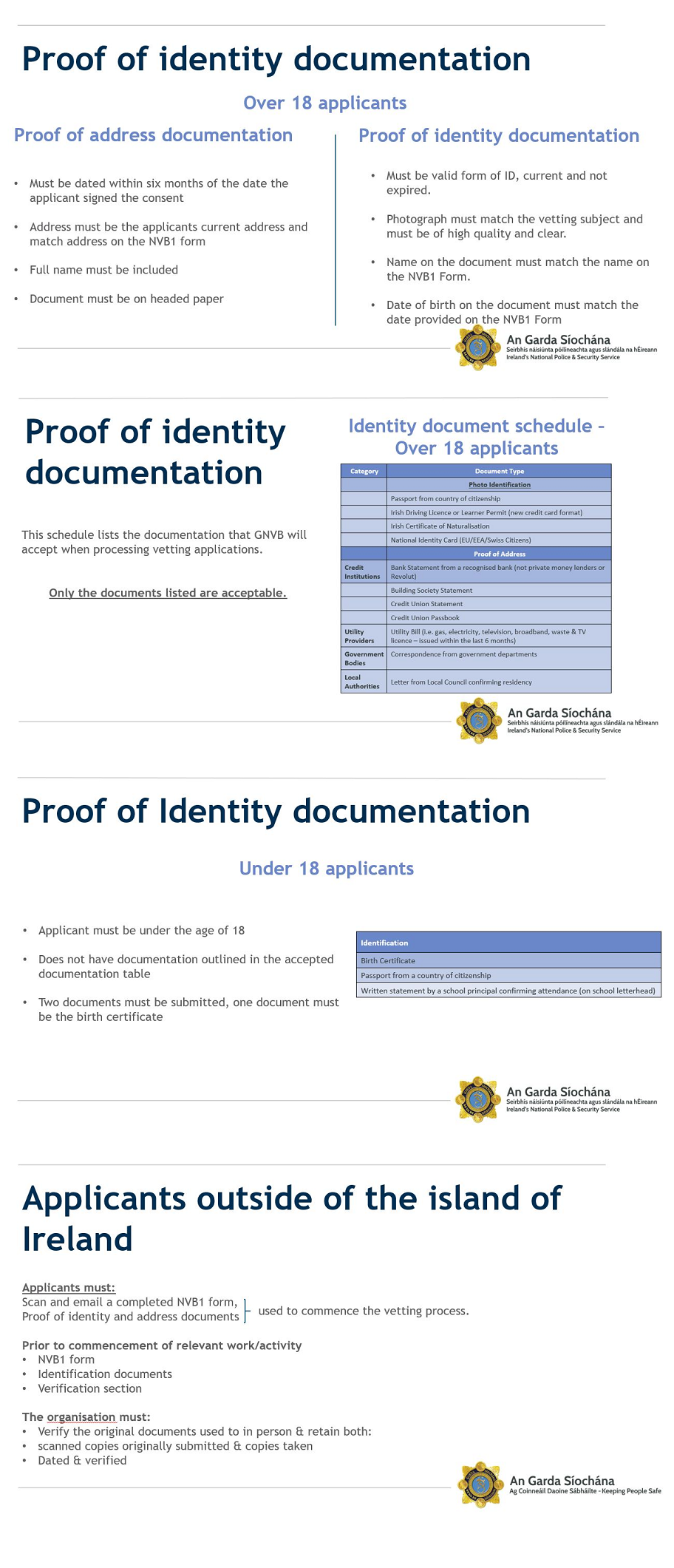
Organisations will use the Identity Document Validation tool on the NVB1 or NVB2 to validate a vetting subject’s identity. A person from the organisation or acting on behalf of the organisation will meet the vetting subject and complete the validation questionnaire on the NVB1 or NVB2 form.
NVB1 & Identity Document Validation Form
Section 1: Photographic ID
Is the photographic document, being relied upon, current and not expired?[ ] Yes [ ] No
Is the photograph on the document a true likeness for the vetting subject?[ ] Yes [ ] No
Is the photograph of high quality and clear? [ ] Yes [ ] No
Is the date of birth on the document matching the date provided on the NVB1 Form?
[ ] Yes [ ] No
Is the name on the document exactly matching the name provided on the NVB1 Form?
[ ] Yes [ ] No
Section 2: Proof of Address
Is the address document dated within six months of the consent date? [ ] Yes [ ] No
Is the address on the proof of address document matching the address provided on the NVB1 Form? [ ] Yes [ ] No
Is the vetting subject's name included on the proof of address document?[ ] Yes [ ] No
Is the document acceptable as proof of address document, as per Identity Document Schedule? [ ] Yes [ ] No
Section 3: NVB1 Form
Is the NVB1 form dated and signed by the vetting subject? [ ] Yes [ ] No
Is the role accepted to be relevant work or activity? [ ] Yes [ ] No
Is the Consent Box ticked? [ ] Yes [ ] No
Section 4: Document Confirmation
I have physically seen and retained a copy of the following documents: (Please check all that apply)
Completed NVB1 Form (original) [ ] Yes [ ] No
Photographic ID Passport [ ] Driving Licence [ ] National ID Card [ ]
Document Reference No. _________________________________
[ ] Yes [ ] No
Proof of address [ ] Yes [ ] No
If you have answered No to any of the above questions the vetting subject has not met the criteria to continue with the vetting process
Section 5: Validator Information
Validator's Name (PRINT NAME): __________________
Validator's Signature: ____________________________
Date of Validation: _______________________________
The Act states that a relevant organisation shall not permit any person to undertake relevant work or activities on behalf of the organisation unless the organisation receives a vetting disclosure from the National Vetting Bureau in respect of that person. There are 2 exceptions
Where an organisation applies for vetting disclosures to the Bureau through another relevant organisation that is registered on the register of relevant organisations and the other relevant organisation are processing vetting applications on their behalf and
Where relevant organisation have in place a joint agreement in accordance with Section 12(3A) of the Act.
Retrospective vetting is referred to in Section 21 of the Act. The relevant organisation shall, where the person concerned has not previously been the subject of an application for vetting disclosure under the Act, not later than such period as may be prescribed by the Minister, make an application for vetting disclosure in respect of that person.
A relevant organisation that, following receipt of a vetting disclosure under the Act in respect of a person shall, after the expiration of such period as may be prescribed by the Minister make a further application for vetting disclosure in respect of that person.
This section provides that the Minister may make regulations to set a period of time within which all retrospective vetting must be complete. The Department of Justice and Equality will make such regulations after the commencement of the Act and has indicated the intention is to set a date of 31st December 2017 as the date by which retrospective vetting must be completed.
A vetting Liaison Person is a trained and registered individual within an organisation who acts as the authorised contact point with the Garda National Vetting Bureau (GNVB) for Garda Vetting. This individual submits vetting application forms on behalf of the organisation and receives the vetting disclosures containing information about vetting subject’s criminal records. They are required to complete training provided by the GNVB, ensuring they understand the vetting requirements and procedures and can handle the sensitive information received.
There is no minimum time stipulated for residency of a country. If you have resided in another EU State or the UK for any period, you are required to tick ‘Yes’ to the question about living outside Ireland. If you have only visited a country on holiday you do not tick ‘Yes’ to the question about living outside Ireland.
Each country has a social security card, while the card may be known by different names across each EU/UK countries, for individual countries it is the equivalent of the Irish PSC card.
The EU questions are the first questions asked on the questionnaire, however your address history is gathered with the vetting subject’s other biographical details.
Vetting subjects are required to provide a complete address history, the checks are completed based on the information provided by the vetting subject